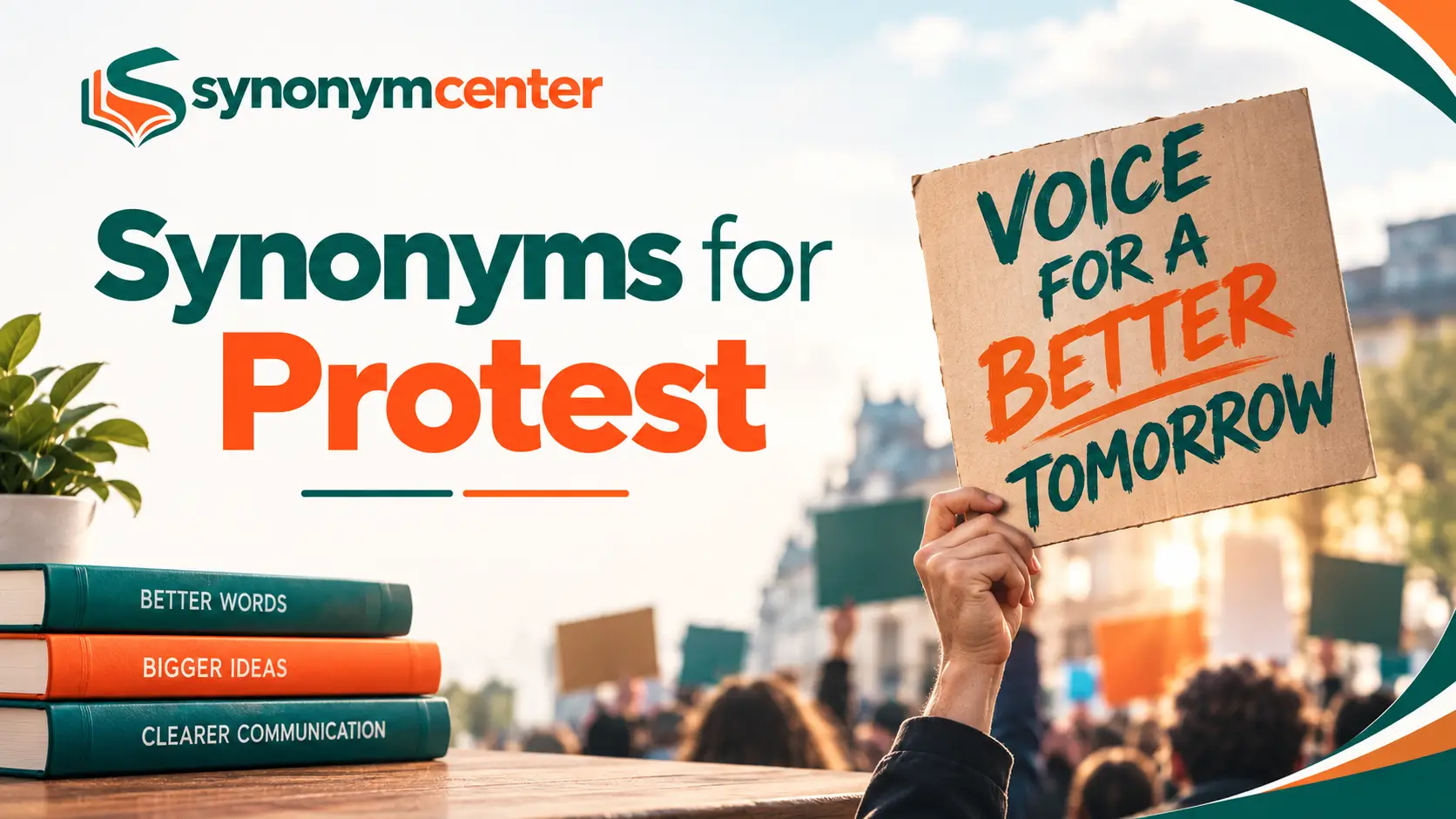
Speaking up against something unfair is powerful — but saying “protest” every time can get repetitive. Whether you’re describing a peaceful march, a worker’s strike, or a formal written objection, English offers many precise words for showing disagreement. Below are 20 genuine synonyms for protest, each with its meaning, type, formality level, and real examples — plus antonyms and answers to common questions.
Quick Reference Table
| Synonym | Part of Speech | Type | Meaning | Example |
| Demonstration | Noun | Peaceful/Public | A public gathering to show disagreement or support | They joined the demonstration to demand change. |
| March | Noun | Peaceful/Public | People walking together publicly to protest | Thousands took part in the climate march. |
| Rally | Noun | Peaceful/Public | A large public meeting to support or protest a cause | The rally drew crowds from across the city. |
| Objection | Noun | Formal/Verbal | A stated disagreement, often in discussion or law | She raised an objection to the new rule. |
| Dissent | Noun | Formal/Political | Disagreement with an official opinion or decision | His dissent caused a long debate in the meeting. |
| Opposition | Noun | Formal/Political | Organized resistance to an idea or authority | The opposition spoke loudly against the plan. |
| Rebellion | Noun | Forceful/Political | Open fight against authority or rules | The rebellion started in the small village. |
| Uprising | Noun | Forceful/Political | A sudden collective revolt against power | The uprising spread across several cities. |
| Outcry | Noun | Peaceful/Public | A strong, loud public reaction of anger | There was a huge outcry after the unfair law. |
| Strike | Noun | Organized/Labor | Refusal to work as a form of protest | Workers went on strike for higher wages. |
| Petition | Noun | Formal/Written | A signed formal request for change | They signed a petition for cleaner parks. |
| Revolt | Noun | Forceful/Political | Open resistance against control | Citizens planned a revolt against the unfair tax. |
| Resistance | Noun | Ongoing/General | Continued act of opposing or fighting back | The resistance grew during the unfair rule. |
| Boycott | Noun | Organized/Economic | Refusal to buy or use something as protest | People decided to boycott the new product. |
| Protestation | Noun | Formal/Verbal | A strong, formal declaration of disagreement | Their protestation was heard by the authorities. |
| Sit-in | Noun | Peaceful/Direct action | Occupying a place and refusing to leave, in protest | Activists staged a sit-in at the office. |
| Picketing | Noun | Organized/Labor | Standing outside a place with signs to protest | Workers were picketing outside the factory gates. |
| Walkout | Noun | Peaceful/Direct action | Leaving a place together to show disagreement | The students staged a walkout to demand change. |
| Insurrection | Noun | Forceful/Political | A violent uprising against a government | The insurrection was quickly put down by police. |
| Grievance | Noun | Formal/Written | A formal complaint about unfair treatment | The union filed a grievance over unsafe conditions. |
Demonstration
Pronunciation: dem-uhn-STRAY-shuhn
A demonstration is a public gathering where people show their feelings about an issue, usually disagreement, though sometimes support. Demonstrations range from small local gatherings to massive marches and are almost always peaceful.
- The citizens held a demonstration to support the new law.
- Thousands joined the demonstration in the city square.
- The demonstration lasted all afternoon without any problems.
March
Pronunciation: MARCH
A march is when a group of people walk together, often along a planned route, to protest or draw attention to a cause. It’s one of the most visible and common forms of public protest.
- Thousands took part in the climate march downtown.
- The march ended peacefully at the government building.
- Organizers planned the march for a Saturday afternoon.
Rally
Pronunciation: RAL-ee
A rally is a large public meeting where people gather to support or protest a cause, often with speeches, chants, and signs. Rallies are usually more stationary than marches.
- The rally drew crowds from across the city.
- Speakers at the rally called for immediate reform.
- The union organized a rally outside the capitol.
Objection
Pronunciation: uhb-JEK-shuhn
An objection is a stated disagreement, often used in formal settings like meetings, courts, or debates. It’s a precise, individual way to say “I do not agree,” without necessarily involving a group.
- She raised an objection to the unfair rule.
- He voiced his objection during the discussion.
- Their objection made the committee reconsider.
Dissent
Pronunciation: dih-SENT
Dissent describes disagreement with an official opinion, policy, or decision, especially within a group or government. It’s more formal than protest and often associated with speech or writing rather than public gatherings.
- The senator expressed his dissent clearly.
- Her dissent led to a new debate.
- Many workers voiced dissent against the new policy.
Opposition
Pronunciation: op-uh-ZISH-uhn
Opposition refers to organized resistance against an idea, policy, or authority, often from an identifiable group (such as a political opposition party).
- The opposition spoke loudly against the new law.
- He joined the opposition to challenge the unfair rules.
- The community’s opposition made the council reconsider.
Rebellion
Pronunciation: rih-BEL-yuhn
Rebellion is open, often forceful, resistance against authority or rules. It carries more intensity than a demonstration and can involve defiance of laws or leadership.
- The rebellion started in the small village.
- Young people joined the rebellion to demand freedom.
- The government faced a major rebellion last year.
Uprising
Pronunciation: UP-ry-zing
An uprising is a sudden, often widespread revolt by a group of people against those in power. It suggests a spontaneous surge of collective resistance.
- The uprising spread across several cities within days.
- Historians studied the causes of the 1848 uprisings.
- The uprising forced the government to negotiate.
Outcry
Pronunciation: OUT-kry
An outcry is a strong, loud public reaction of anger, often triggered by a specific unfair event or decision. It doesn’t require organized action — just widespread, vocal disapproval.
- There was a huge outcry after the unfair law passed.
- Citizens’ outcry stopped the plan from moving forward.
- The outcry on social media gained worldwide attention.
Strike
Pronunciation: STRYKE
A strike is when workers stop working to protest conditions, pay, or treatment. It’s one of the most direct and organized forms of labor protest.
- Workers went on strike for higher wages.
- The teachers’ strike lasted two weeks.
- Employees planned a strike to demand better safety.
Petition
Pronunciation: puh-TISH-uhn
A petition is a formal, usually written request signed by many people asking for a change. It’s a peaceful, structured way to demonstrate collective support for an issue.
- They signed a petition for cleaner parks.
- The petition asked for safer streets in the city.
- Hundreds of people added their names to the petition.
Revolt
Pronunciation: rih-VOHLT
A revolt is open resistance or fighting against control, often bigger and more serious than a standard protest. It can involve real risk to those participating.
- Citizens planned a revolt against the unfair tax.
- The revolt lasted for several days.
- Young leaders organized the revolt in secret.
Resistance
Pronunciation: rih-ZIS-tuhns
Resistance describes the ongoing act of opposing or fighting back against something, whether through visible protest or quieter refusal to comply.
- The resistance grew during the unfair rule.
- Local groups showed resistance against the project.
- She joined the resistance to protect her community’s rights.
Boycott
Pronunciation: BOY-kot
A boycott is a refusal to buy, use, or support something as a form of protest. It’s an economic strategy that pressures companies or institutions through lost business.
- People decided to boycott the new product.
- The community organized a boycott of the store.
- Students boycotted the cafeteria over poor food quality.
Protestation
Pronunciation: pro-tes-TAY-shuhn
Protestation is a strong, formal declaration of disagreement, often spoken or written to authorities. It’s a more elevated, less common word than “protest,” best suited for formal writing.
- Their protestation was heard by the authorities.
- He made a protestation about the unfair rules.
- Protestation during the meeting changed the final decision.
Sit-in
Pronunciation: SIT-in
A sit-in is a form of direct-action protest where participants occupy a space and refuse to leave until their demands are addressed. It’s associated with civil rights and student movements.
- Activists staged a sit-in at the company’s headquarters.
- The sit-in lasted three days before officials responded.
- Students organized a sit-in to protest tuition increases.
Picketing
Pronunciation: PIK-uh-ting
Picketing involves standing outside a workplace or building with signs to protest, usually during a labor dispute or strike, aiming to inform the public and discourage entry.
- Workers were picketing outside the factory gates.
- The union organized picketing during contract negotiations.
- Picketing continued despite the cold weather.
Walkout
Pronunciation: WAWK-owt
A walkout is when a group of people leave a place together, such as a classroom, workplace, or meeting, to show disagreement. It’s a quick, visible way to protest without violence.
- The students staged a walkout to demand change.
- Employees staged a walkout to protest unfair treatment.
- The walkout lasted for several hours until talks began.
Insurrection
Pronunciation: in-suh-REK-shuhn
An insurrection is a violent uprising specifically aimed at overthrowing a government or authority. It’s a much stronger, more serious word than “protest” and usually implies illegality.
- The insurrection was quickly put down by police.
- Historians debated the causes of the failed insurrection.
- The government charged several people over the insurrection.
Grievance
Pronunciation: GREE-vuhns
A grievance is a formal complaint, typically submitted in writing, about unfair treatment — common in workplaces and unions as a structured first step before larger action.
- The union filed a grievance over unsafe working conditions.
- She submitted a formal grievance to human resources.
- The grievance process took several weeks to resolve.
Antonyms of Protest
Understanding the opposite of protest helps clarify when these words apply:
- Approval – agreement or acceptance of something
- Compliance – following rules or requests without resistance
- Support – backing an idea, decision, or authority
- Acquiescence – accepting something reluctantly but without objection
- Agreement – shared opinion with no disagreement
Frequently Asked Questions
What’s the difference between a protest and a demonstration? “Protest” is the general term for expressing disagreement, while “demonstration” specifically refers to a public gathering — so every demonstration is a protest, but not every protest is a demonstration (a strike or petition, for example, doesn’t require a public gathering).
What’s a formal word for protest in writing? “Dissent,” “objection,” “protestation,” and “grievance” are strong, formal choices for academic, legal, or workplace writing.
What’s the difference between a strike and a boycott? A strike is workers refusing to work; a boycott is consumers or the public refusing to buy or use something. Both are organized, non-violent forms of economic protest.
Is “insurrection” the same as “protest”? No. Insurrection specifically implies a violent attempt to overthrow authority, while most other words on this list describe peaceful or lawful forms of disagreement. Use it carefully, as it carries legal weight.
Final Thoughts
From a quiet written objection to a large public rally, English gives you many ways to describe disagreement, each with its own tone and intensity. Choose peaceful, public words like march, rally, or demonstration for organized events; formal words like dissent, objection, or grievance for written and workplace contexts; and stronger words like uprising, revolt, or insurrection only when the situation truly calls for that level of intensity.

Ethan creates easy-to-understand vocabulary content, including synonyms, word meanings, and useful language tips.